News
Egyptian Adventure
January 31, 2011
 </img>
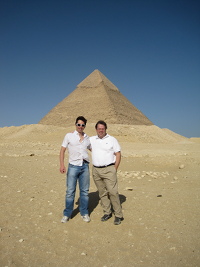
On December 18 and 19 Peter Tonellato and I delivered keynote talks and multiple training sessions in the areas of Cloud Computing (December 18) and Personalized Medicine (December 19) at Nile University. All of this was geared towards building new partnerships with our Egyptian colleagues at Nile University. We look forward to forging ahead, despite the recent conflicts that have erupted over the last month.
</img>
On December 18 and 19 Peter Tonellato and I delivered keynote talks and multiple training sessions in the areas of Cloud Computing (December 18) and Personalized Medicine (December 19) at Nile University. All of this was geared towards building new partnerships with our Egyptian colleagues at Nile University. We look forward to forging ahead, despite the recent conflicts that have erupted over the last month.
Genotator Gets High Visibility
December 01, 2010
Our newly published tool, Genotator, has been flagged as highly accessed by BMC Medical Genomics. Read the paper here.
How our Mind Remembers and Categorizes Animal Names
October 15, 2010
A stellar alumnus from the lab – J. Goni – just published an outstanding paper entitled “the semantic organization of the animal category: evidence from semantic verbal fluency and network theory” Semantic memory is the subsystem of human memory that stores knowledge of concepts or meanings, as opposed to life-specific experiences.
How humans organize semantic information remains poorly understood. In an effort to better understand this issue, we conducted a verbal fluency experiment on 200 participants with the aim of inferring and representing the conceptual storage structure of the natural category of animals as a network. This was done by formulating a statistical framework for co-occurring concepts that aims to infer significant concept–concept associations and represent them as a graph. The resulting network was analyzed and enriched by means of a missing links recovery criterion based on modularity. Both network models were compared to a thresholded co-occurrence approach. They were evaluated using a random subset of verbal fluency tests and comparing the network outcomes (linked pairs are clustering transitions and disconnected pairs are switching transitions) to the outcomes of two expert human raters.
Results show that the network models proposed in this study overcome a thresholded co-occurrence approach, and their outcomes are in high agreement with human evaluations. Finally, the interplay between conceptual structure and retrieval mechanisms is discussed.
Get Your H-Index On
September 21, 2010
Google now provides an H-Index feature available here, which will no doubt soon factor into tenure decisions. Start pushing out those pubs.
Wall and Tonellato Invited to Give Lectures at Incob Tokyo
September 09, 2010
Peter Tonellato and I were invited to speak at an upcoming international conference on computational biology, to be held in Tokyo. I will be giving a keynote lecture on Personalized medicine and the future of individualized health care. Read more here.
Abstract: With the emergence of direct-to-consumer personalized genomics and the $1000 genome on the imminent horizon, the number of individuals undergoing genetic testing is accelerating. Concomitant with this rise is an increasing awareness that our methodologies and our current clinical knowledgebases may be inadequate to accurately measure risk of disease. Mutations that are marked in authoritative genetic databases as highly penetrant in causing disease congenitally or in early childhood are being discovered in asymptomatic, healthy adults. The number of these false positives findings is projected to rise dramatically because many of the current annotations for known mutations have not been developed for the asymptomatic, well population. In this talk, I will discuss our efforts to determine the frequency of false positives in present day genetic testing and their likely impact on the practice of personalized medicine. I will also discuss our work on clinical-grade annotation of human genetic variation, and related efforts in educating future doctors on the potential of genomics on individualized healthcare.