News
Autism at Big Data in Biomedicine
May 28, 2013
Dr. Wall participated in the inaugural Big Data in Biomedicine conference at Stanford last week, where he gave a talk about the direction and possibilities of the lab’s autism research.
The presentation is mentioned in the Mendels Pod writeup of the conference.
Also, have a look at some of the pictures from the event!
Innovation award and upcoming conference
April 28, 2013
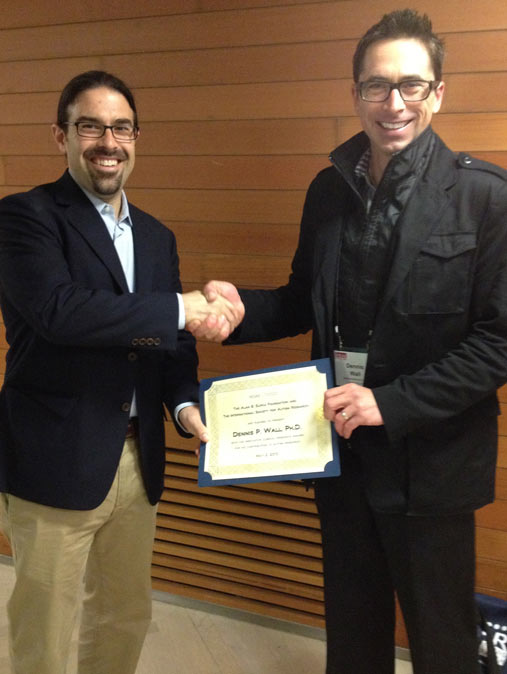
Dr. Wall was selected to receive the the Slifka / Ritvo Innovation in Autism Research Award for outstanding achievement in clinical advancement of autism, and will be presented with this award at the international autism conference in Spain next week. The conference is the International Society for Autism Research’s IMFAR 2013. Dr. Wall will be presenting at the conference as well.
New Version of Roundup
April 17, 2013
Roundup, an online application that lets you browse orthologs computed with our RSD algorithm, has been updated.
The latest version of Roundup, 4.0 is now available at roundup.hms.harvard.edu. This version includes approximately 282 eukaryotic species (up from approx. 199), a total of 2044 genomes (up from 1807) and approximately 1425 species (up from approx. 1222).
Happy Autism Awareness Month
April 11, 2013
We are working on creative ways to “light it up blue” this month. We have decorated our lab and dressed top to bottom blue on April 2nd for World Autism Awareness Day. Up next is our blueberry cupcake party!
Aside from these community-building Autism Awareness lab events, we are proud of the progressive and productive year we have had here at the Wall Lab! We are making great gains in our research every day, and many of our successes are because of YOUR support. In the past year, we have published 10 papers, partnered with Boston Children’s Hospital in our research, reached close to 4,000 “likes” on Facebook (thank you!), and received press highlighting our research gains (e.g., an article in Time).
We are currently testing and re-testing our methods for a faster and earlier path to Autism diagnosis. In the next year, we hope to finalize the work of detecting autism through home videos and brief questionnaires. All of this work will soon enable a mobilized tool that will help new families reach clinical care as early and as regularly as needed. Check back soon for a link to the new video submission site, and for updates on our plans for bringing this tool to entire community in need of autism information and care.
Clinical Triage of Autism
April 02, 2013
In a triage method under development by Dennis Wall, director of the Computational Biology Initiative at Harvard Medical School, parents answer seven questions about their child’s behavior and submit a five-minute video taken during a playdate, birthday party or other everyday social situation. Three trained evaluators score each video for eight behaviors, including eye contact and imaginative play.
“I think it’s very important to be thinking about combining information from multiple sources, particularly not just relying on parental report but being able to validate that report in some way,” says Zachary Warren, assistant professor of pediatrics at Vanderbilt University in Nashville, Tennessee, who is not involved in Wall’s efforts.
Wall argues that a video might even offer an advantage over existing gold-standard tools, in which clinicians observe the child in an office.
“A child in an artificial environment tends to do different things than the child does in his or her natural environment,” Wall says. “The natural setting can be very powerful for showing signs that can enable faster decision-making.”
To develop this system, Wall used an artificial intelligence approach called machine learning, which identified a subset of questions from the ADI-R and behaviors evaluated by the ADOS as being most crucial to producing an autism diagnosis.
Read more here